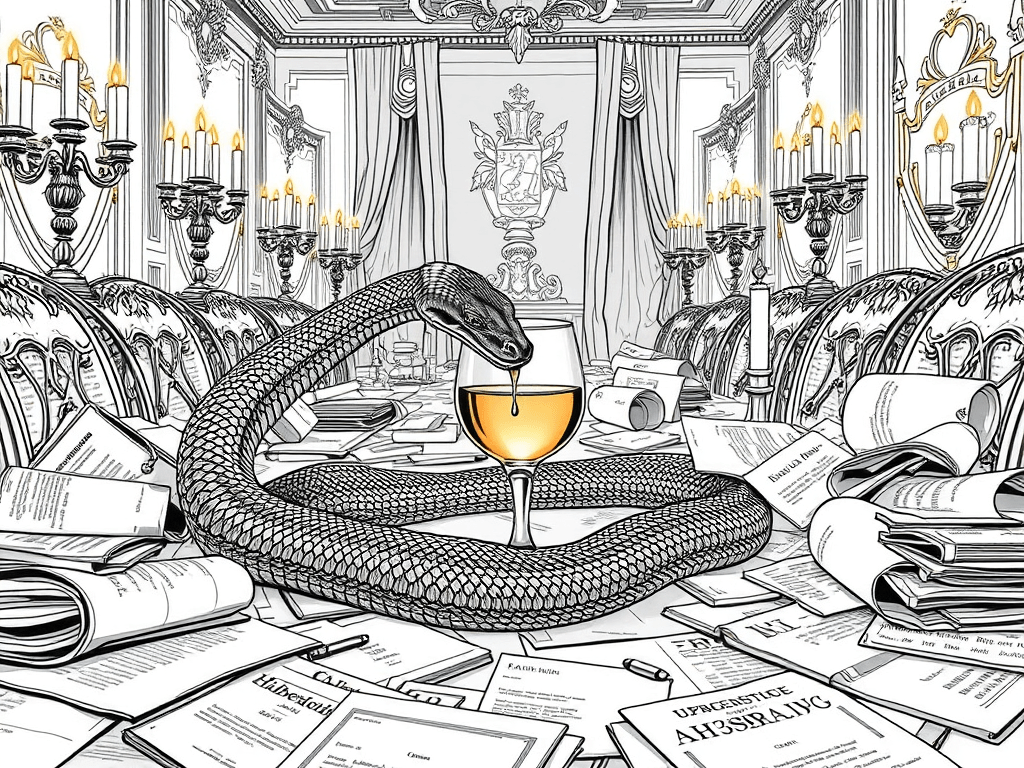
A Glass of Calvados
The halls of the royal palace were rank with the toxic smells of liquor and wine, smoke and bile, all poorly masked under a thin veil of soap and water. Jakob sighed as he navigated the overturned chairs and tails of hanging tablecloth, searching amongst the debris. The hearth crackled, dissolving the bitter cold of the March morning. The banners of the Hapsburgian house hung stale along the walls, no finer than the strewn newspapers around the tables, celebrating the end of the war, and the exile of the tyrant from Europe. Despite its garish appearance, the filthy conference hall held debates of war and peace, though these were not the matters that had sent the room into a state of disarray. The drinks were not drunk out of building oral confidence, nor were the chairs overturned in the act of a defiant prince, rising quickly to speak out against opposing views. No, debauchery itself reigned supreme in this hall of indulgence.
Jakob’s rank among the court required him to attend to these halls, yet he was not of the stature to sit at the tables. He scoffed at the notion, considering how truly dependent those superior to him were on his diligence and work ethic, the entire office up in flames if not for his efforts. The machinations of the Holy Roman Empire were akin to decoding the plans that God had set for man, yet Jakob played them like a true master of puppets, always pulling the right string, or pushing the right messenger, to keep himself afloat.
It was a symptom he adopted from his mother, he supposed: caring too much. He engaged in the world of politics not for personal power, but for the same reasons his mother served the local duke on the weekends, for those we love. She hated working for that blubbering oaf, and he hated working for the crown, yet she got Jakob through private education with the influence gained with the duke, and, with luck, Jakob could make serious change within the Empire. People like his mother could live their own lives, without living at the behest of others. The wealth could be redistributed, allocated in a way to suit the needs of the people! And yet, those that sat above him, that rarely heeded strong advice, continue to build a future for no one but themselves.
Their arrogance, their filth; it sickened him. As Jakob looked around at the blatant misuse of time and wealth, he felt something move past his leg. He looked down to see the scaly back of a long, black snake, easily as thick as his fist, coil over chairs and plates, navigating the same sprawl Jakob had moments before. Slithering under tablecloth, the snake emerged mere seconds later, with a bottle of calvados schnapps. The snake approached Jakob once more, breaking the ceramic plates beneath him this time as he slid across the floor. His head slowly rose in a metronomic sway, turning to face Jakob. His eyes were piercing blue, and his forked tongue flicked as he began to speak.
“Finest spirit in the west,” he hissed. Gliding over a table, the snake leaves the bottle as he moves along, the waxy label facing Jakob, who loses sight of the snake as he stares at the bottle. He had seen the snake before. They were quite well acquainted, in fact. Yet, recently, Jakob had begun to loath its’ visits. His lips curled into a slight snarl at the liquor as he spoke; “frivolous French filth.” As he looked on in disgust at the drink, the snake coiled up his back until it rested its head on his shoulders.
“Aged thirty years,” the snake said, “it deserves to to be enjoyed, not tossed aside in a drunken stupor. You deserve a glass, just as much as it deserves you.” With his long form, the snake slides an ornate tumbler across the table, with a cube of ice perfectly set in the middle. “In Prussian crystal, no less.”
“What is there to celebrate?” Jakob asks, turning his gaze to the perched serpent, whose body continued to methodically pour the sweet apple brandy into the chilled glass. “Why, the end of the war, my boy,” The serpent replied.
Jakob immediately saw through the comment. “Do I look like a university student to you? The horrors of the battlefield pale in comparison to the stifling of the people.” The serpent snickered as he glared at him.
“You claim to be no schoolboy, yet still speak in substanceless pleas for attention. Tell me, grand orchestrator of this fine gala, who are ‘the people’ you speak of? And who stifles them? Your fellow Hapsburgs seem to be doing marvelously.”
Despite his familiarity with the Serpent, Jakob was still taken aback at his forwardness and wealth of information. “I speak of all the World’s people, not just my fellow Austrians. The workers of the world demand justice, from the Polish farmer losing his land at the hands of Cossacks, to the people of the East, held by the vice grip of the colonies. Those in power, those on the throne, are the ones who profit. The many held captive by the few: that is true horror.”
The snake had long since finished pouring the calvados, having been watching Jakob in his speech. His head slid down. “Ah, but what of the peace those in power maintain? Surely you’d prefer boys dying at home than in foreign lands, or god forbid, slain by their fellow countrymen?” His eyes drove through Jakob.
Jakob was all too familiar with the price paid in war. His exploits through the Holy Roman Empire included a healthy tenure within the army, commanding ranks of men against the unending wave of the French. Yet, he returned home, unlike many others, and held with him the rage of an officer, scorned by his mistakes. “Those who stop their fellow countrymen in their pursuit of freedom are no brothers of mine! And the loss of life is the toll the Revolution takes to gain results. The blood waters the gardens, and what comes next is the harvest of the people.”
The snake slid across Jakob’s shoulder, the serpent’s head floating nearly half a meter away from Jakob’s, as his glassy eyes looked on in faux-shock. “I see, you supported the French crusade, heartbroken at the end of great Napoleon’s reign! The son of the revolution!”
Jakob, for the first time since the conference had begun, grew a wry smile, even chuckled lightly at the serpent. “To assume I would associate the people of the world with the French war machine proves you to be a bigger fool than I thought. No, you daft reptile, it is the republics of the world that lose in this war, as this gang of monarchs reassert their vestigial kingdoms. Napoleon was no son of revolution, only a symptom of lingering greed from the old. We had a chance for greatness, a chance for freedom, and they crushed it. We now stand at the edge of an abyss, and I stand and watch as we are shepherded off the cliff, and I am helpless to stop it.”
“My boy, your dejection blinds you to opportunity.” The serpent turned his head to the mess around them, before returning his gaze to Jakob. “The shepherds are slothful, unaware of your guile. Punish their arrogance, lead the masses from the abyss and build your own kingdom!” The serpent pulled the sweating glass of brandy across the table while nudging Jakob closer. The Italian oak table began to warp under the growing ring of water left by the glass.
Jakob was silent for a moment, pondering the serpent’s words. He had grown up with the serpent, their relationship as convoluted as the serpent’s existence. There was a time, long ago, when Jakob was rather close to the serpent, consistently seeking his counsel and discussing his frustrations with the world with him. However, Jakob changed, grew in position, and, as such, the serpent grew in his boldness. What was once a garden snake, one that could fit in his pocket during walks to school, now lurked at an amazonian length, his influence weighing heavier and heavier on Jakob as the years go by.
After a moment of contemplation, Jakob turned from the table, refusing to look the serpent in the eye, walking to pick up strewn silverware at his feet. He could feel the gaze of the serpent on him, burning into the back of his head. Damn, did it burn. Yet, the heat began to feel comfortable.
“I deserve no kingdom.” The serpent roared in laughter, the lower half of his body rolling from the table as he turned his full attention to Jakob. Jakob persisted in his avoidance of the serpent’s gaze, even as the top of his shoulders felt the slightest constriction of the serpent.
“And you believe they did?” the serpent motioned to the mess that surrounded them. “In case it wasn’t obvious, there is no mandate of heaven. The ones in charge are the ones who decided to be in charge.” the serpent broke his gaze towards Jakob, only for a moment. His stomach turned, before he could bear to look at Jakob once more, with the same fury in his eyes. “Yet, their decisions are not final. They used to be like you, idealistic and proud, angry at the generations before at their inactivity, yet still afraid to step out of the shadows of history. Kings are what they make of themselves, Jakob. From what I see, you have made yourself far greater than any man before. Why waste it at the feet of men beneath you?”
Jakob’s nose scrunched. He had heard that title before: to be beneath. He figured, if the beholder were gospel, then he truly would have been beneath every two-bit diplomat who thought themselves above their servant. Yet, their perceptions and judgements proved ultimately fatal, as Jakob walked away from every sabotaged campaign higher up the ladder than he once was. He never wished to see someone as “beneath” him, yet he couldn’t deny his overwhelming sense of superiority to the buffoons that had created the mess he stood in. How odd, that his disgust in his actions made him more proud of himself.
“Even if I were to pursue my own kingdom, as you imply,” Jakob said, shrugging his shoulders against the serpent, sliding his weight down to his elbows as he moved towards the chair overturned near the glass, “How am I supposed to usurp the lords of the old world? If this circus around us holds even a shred of truth, it is this: the lords and ladies of the throne would rather serve each other than their people.” Jakob leaned into his opulence, holding the head of the serpent in a cup of his left hand, his right supporting his tail.
The serpent, while no longer holding such a constrictive grip on Jakob, rose his neck higher, tilting his head ever so slightly in understanding. “Ah, as is the fear of every future king. Tell me, Jakob, did Uranus expect his kingdom of heaven to be overthrown, after eons of harmony and peace, by his son, no less? Did Chronos, the son of Uranus, expect his empire of titans, forging the Earth to their whims, to fall, at the spearpoint of his three boys? There is no everlasting, only the certainty of change. Did they not make you who you are, Jakob?” the serpent motioned towards the room once more.
Jakob brought an overturned chair upright to the table, pausing briefly at the serpent’s last remark. He enjoyed the act of hefting the heavy, wooden chair as he brought it to its legs, the strain on his arms warranting the rest he took in its embrace. The weight of the serpent never left his mind, his neck craning slightly down under the weight. His elbows dropped to the table to compensate, allowing Jakob to look into the amber liquid of calvados before him in depth. The words of the serpent continued to echo through his head.
He wasn’t wrong; They had made him. Not the kings themselves, but the world they created. In ripples of the calvados, Jakob could see the bombarded shores of the Rhine, the wave of French blue and red charging across the fields, and the fear in his friends’ eyes, dropping their rifles, as they turned to flee. Those fields, those faces of terror, etched themselves into the fabric of his mind, haunting his every waking moment. However vehement in his lust for revolution, the pains of the past continue to haunt his present.
“I refuse to merely continue the cycles of the past. Even if I were to slay these supposed titans, which you have still yet to explain how,” Jakob explained, hefting the serpent off his shoulders and onto the table with a thud, “I’d be no different than them.”
The serpent settled into his spot on the table, taken aback by Jakob’s bluntness. He coiled into a horseshoe shape on the table, circling the bottle and glass in the process. “My boy, the cycle continues to grow. Why would I tread old ground? Just as evolution continues to improve on nature’s perfection, your reign will be greater than those before you! You will be the king of kings! Isn’t that what your mother would want, for her dear boy?”
At the mention of his mother, Jakob turned to look into the serpent’s eyes, for the first time since his proposition, and what he saw made him shrivel in fear. The serpent, who up until then, had been a predator of intelligence and composure, now stared at Jakob with hunger, his eyes wide and bloodshot, his teeth bore akin to a ravenous wolf, his head primed for a strike. But, the eyes; it was the eyes that chilled Jakob’s skin to gooseflesh. Although the breath came from the chest, Jakob could see the eyes heave in the serpent’s skull, anticipating his every move. Jakob would not succumb to such predation.
Jakob, shaking in fear, slid the glass of brandy across the table, refusing to break eye contact with the serpent, resting his chin in a cradle of his hands. “You have yet to tell me of my rise to the throne, old friend.”
The serpent’s body grew still at the comment, the hunger in his eyes flashing to fury, before returning to a chilling sense of calm. A smile once again grew across his face, yet one no reptile could make. The muscles in his cheeks seemed to tone on command, his brow rising to a wrinkled forehead, his teeth filling his mouth to an uncomfortably human degree. The body of the serpent began to writhe and contract, all the while his head remaining perfectly still, as the scales on his surface began to melt and meld together in a clean sheet of skin. All the sudden, the body beneath the serpent’s head began to expand and bulge, as the rest of his body morphed in suit. Jakob watched on as the serpent’s form writhed and shifted into that of a man, one of fair complexion and a healthy build, with jet black hair smoothed into an executive contour. He wore a black suit, a cream undershirt contrasting a rose red necktie. Without breaking eye contact with Jakob, the man reached for the calvados, taking a healthy whiff before gulping a mouthful down.
“My boy,” the man said, his voice unchanged from his reptilian hiss, “It’s quite simple.” Jakob still had not fully come to terms with the sudden change in form. For their years of banter, he had never seen the serpent as anything else. He could recall back to primary school, having his lunch knocked to the ground by Elias, the largest boy in the yard, when the serpent would coil around his leg, whispering plots of revenge into his susceptible ears. There were no holes in his plans, as his bullies would receive their comeuppance, while he walked away scott free. To see the serpent in this form, indistinguishable from his fellow man, shook Jakob with a realization of scope he had refused to confront until then.
Growing up, Jakob had seen the serpent as an imaginary friend, one who would affirm him in doing what he wanted to. An excuse, as his siblings would call it. His brothers would look at him with contempt, as if they were incapable of what he could do. To manipulate teachers, parents and friends. It confused Jakob, that his siblings hated him so. Why had they seen his actions as so vile?
Then, one day, he figured it out. He didn’t remember when he did. For all he knew, it could’ve been during any ordinary mealtime. He looked across the table of meat and drink, at his brothers and sisters feasting on their meals. It was then, as they bickered and ate, that he could see why they hated him so; they could not see the serpents.
Across their necks, coiled against their torsos, the serpents were everywhere. They whispered infinite evils into his siblings’ ears, influencing unimaginable horrors. Their tails smacked plates and glasses, spilling wine and sprawling baskets of bread, yet their actions went unnoticed. Jakob watched in a mixture of horror and disbelief as his siblings, weighed with sin, persisted unaware of their burdens. He couldn’t understand their acceptance of the weight, until he considered that, maybe, they all knew. Perhaps they all saw each other’s serpents, ruining each other’s lives. Perhaps they knew Jakob could see them, and merely couldn’t muster themselves to accept it. It hurt him most of all, that they all sat there, all screaming in silence, all held by their serpents, yet unable to save each other. They all drowned under the weight together.
So how, after decades of pain, after carrying this parasite up the ladder of power, did it decide to morph, shift into this grotesque mannequin of man? Had it not trusted Jakob, after all he had done for him, to reveal this form? Anger boiled inside Jakob brighter than it ever had, every muscle in his body fighting to keep him from leaping across the table at the man’s throat.
The man saw this all course through Jakob’s mind, and relished in its turmoil. He smirked across the tumbler of brandy. “You fight against a band of oligarchs, a ring of monsters you perceive to be unbreakable. Yet, you couldn’t be further from the truth. You sit atop the means of their destruction, you just simply refuse to see it.”
The man slid the glass back towards Jakob, magically refilled with the same, expensive calvados. The ice cubes, once more reformed to geometric perfection, swirled enticingly across the surface of the liquor, causing Jakob’s eyes to widen in involuntary anticipation. The sweet apple aroma filled the room, causing him to tear up at the thought of his mama’s strudel. God, what he would do to sit with her once more, her letting him blabber about whatever he read in the paper through mouthfuls of apple filling, completely content to listen to him speak. He missed her, so much that he briefly forgot where he was, and who he was talking to. He merely sat and thought, remembering how warm her hug was, how safe she made him. For a moment, he was truly happy.
“You long for something simpler,” the man said, reading Jakob’s melancholy from across the table, “and I believe I can provide.” Amongst the piled plates and dishes across the table, sat a pile of neatly arranged papers. The man drew from the top of the stack and held it with conviction.
“The old world is held aloft by five thrones, and those thrones only remain through the magical, resolute strength of trust.” The man waved the paper in his hand, creasing the lettering while he flapped the words in Jakob’s face. “If you were to, let’s say, mold this trust, this eversoft material of will, into one of complexity and doubt,” the man rose the glass of brandy to its lips, rolling it across its base in a circular form, “the house of cards would surely topple.”
Jakob watched the treaty waver in the man’s grasp, suddenly realizing his greater scheme. The kingdoms of his land, from Austria to England, were built atop pillars of salt. He sat amongst the means of rebellion: hundreds of promises and pacts, all forged through ink, all susceptible to conspiracy. The man’s eyebrows raised as he saw Jakob look across the room, finally understanding his potential. He tried not to laugh as Jakob fought back tears, overwhelmed at the realization.
The means of freedom were at his fingertips for years. He had served the highest heads of Austria for half of the last century, completely unaware of his own influence over the future of his nation. How much of this was his fault? How much suffering and death, all in the name of something so vile, for the honor of those uncaring? The families that lost their land, the thousands of soldiers, young men, thrown away…
“Ah,” the man spoke once more, reeling Jakob from his deep thought, “you must be thinking of Charles.”
Jakob’s tears began to flow freely after hearing his name, deep sobs overshadowed by the booming laughter of the man, both of them unable to hold back their true feelings. Jakob’s head fell between his arms, his sobs growing more raggedy and desperate, holding back the memories through sheer will, his temple thumping with strain. It was no use. It was time to face the past.
Jakob opened his eyes. He was no longer in the lounge with the man. Instead, he found himself amidst heavy rain in the early morning, overlooking the French countryside, holding his Lorenz rifle tight against his officer uniform. Although his jacket kept out most of the cold, he was nonetheless quite soaked, his socks squishing from his impatient steps. He looked over at the rest of his regiment, his shivers of cold turning to that of dread, as French cannonfire continued to fill the air. The men that stood beside him had no choice but to trust him. Jakob believed he had earned that trust.
A hand clamped against his shoulder. Jakob looked over and saw the beaming smile of Charles. His hair stuck to his forehead in a mat, the golden locks coated in a muddy shade of brown. He held in his other hand a bottle of Kirsh.
“Always such a glum look you have, Jakob. Do not fret, my friend; we stand on the precipice of greatness! We fight like good countrymen, then return to our land, a brighter future forged in our efforts! Now please, have a drink.” Charles placed the bottle firmly in Jakob’s gloved hand. “Your men are beginning to worry.”
Jakob turned from Charles’ still bright smile and towards the ranks of soldiers at his disposal: they were terrified. He cursed himself for being so wrapped up in his own fears, his men clearly adopting his anxieties and shuffling amongst themselves, murmuring comments about the weather, and what good they were doing there anyway. Jakob tore the cork from the bottle without looking down, guzzling a few strong gulps with eyes clenched shut. The rain felt cool against his face. He wished he could smile like Charles.
Jakob had known Charles for many years, attending the same academies since youth. Charles was the first to introduce himself, seeking Jakob out after a rather public fight Jakob had with the other boys at school. Jakob had been stewing for hours at that point over those who nearly broke his nose, the serpent resting in his pocket as they discussed the various means of revenge. However, after Charles had invited Jakob to walk with him down to the bookstore, Jakob found himself slowly forgetting about the other boys who would beat and berate him. It didn’t seem to matter as much when Charles was around. He always kept Jakob occupied with jokes and stories, and Jakob kept Charles company. They became inseparable.
When Napoleon first began his war across Europe, Jakob and Charles had already established themselves within the Austrian military. After some finangling with the higher ups, Jakob was even able to get Charles transferred to his division, serving as his advisor. Together, they were unstoppable, executing advanced, scientific tactics without hesitation or fault. Many high ranking officers heard of their growing renown, and they soon became popular amongst the papers at home, the unbeatable duo that would stop Napoleon in his tracks!
Yet, there was no glory found at the Rhine, where Charles and Jakob had formed against the advancing army.
The sky screamed with hellfire as the first volley of metal and shrapnel crashed against the ranks of men, the cacophony of screams rising from the first strike. There was no chance to brace, no time to reform or retreat. Jakob was flung from his feet, the bottle of Kirsh flying from his hands and crashing against the ground, his head ringing with pain. He was stunned, sprawled on his back, his body singed with burns, his skin sliced with metal fragments. He laid there for about a minute, unmoving, unable to process what had happened. He merely laid there, listening to the shouts of his comrades, and the call to retreat weakly given far too late.
When he did try to rise to his feet, he struggled with great difficulty to remove himself from the bog that had formed around them, peeling himself limb by limb in an attempt not to sink any further. When he finally was able to plant his boots against the ground, all he could see was ruin. The place where his proud soldiers once stood only held a sea of blood and mud. Dozens of soldiers were clumped into the ground, limbs protruding from the ground unnaturally. In the distance, he could hear his remaining men flee. He stood there, watching, processing, preparing to take flight himself, until he could tear himself from the sight, and look over to where Charles once stood.
About fifteen feet away, Jakob spotted the yellow pigments of Charles’ uniform. He froze for a moment, before rushing to his side, tripping over his boots getting trapped in the mud, crawling towards his friend. When he got to his body, he could barely see any of him, except the back of his head down to his shoulders, a piece of metal the size of a dinner plate embedded in his head, his body twitching in a puddle of mud. Jakob threw his hands against Charles’ shoulders, grabbing hold and tugging desperately to pull him up. He sat there for what felt like an eternity, yet it couldn’t have been more than two minutes before Jakob stood up, hands shaking, his face puffy, and shuffled away, under duress of French calvary’s hooves beating against the earth.
“My, I hope that wasn’t too uncomfortable, my boy,” the man spoke once more, making the visage of the French countryside fade away once more into Jakob’s mind. His vision returned, still staring down into the darkness of the table, arms still folded against his head. His tears burned away under the heat of rage that boiled in Jakob. He slammed his hands down against the table, raising his head up forcefully, only to come face to face with the rotted, decayed, mud-caked form of Charles.
Jakob couldn’t speak. The serpent, now a man, continued to shatter Jakob’s understanding and expectations regarding him. What sat before him was a perfect copy of the recovered corpse of Charles, yet breathing and swaying as if alive, albeit quite disoriented.
“I just figured it might be nice for you to remember your dear friends, those who may have suffered from your lack of initiative.” The man stood not twenty feet back, leaning against an ornate pillar. “Things could’ve ended differently, and maybe some of your friends could’ve gotten home. Isn’t that right, Charles?”
The ghastly form of Charles nodded slowly, his bloated eyes piercing through Jakob’s, his face growing into a wide smile. His skin flaked and cracked to Jakob’s horror as his lips separated, letting a mouthful of mud spill out onto the table, the calvados safely in the man’s hands. Jakob stood up, knocking the chair he sat in away as he tripped backwards, sprawling against its back. He sat in shock for a moment, staring at his friend, present in the last form he ever saw him in, praying to God that Charles was okay, wherever he was.
“They aren’t listening, and he isn’t okay. A zealous freak like him? He’s burning for sure. He was just as bloodthirsty and selfish as you! You surrounded each other with the lies that what you were doing was just, that your plans to “fix” the system were right. Give up such thoughts of moral superiority. You’ll join him soon enough, but why not do what he never could? Before eternal damnation, why not have a little fun, send the world once more into hellfire?”
Jakob struggled to pull away from Charles’ unyielding gaze, craning his head towards the man with the most spiteful, unbridled hatred he had felt.
“You know nothing! Charles was a great man, and a dear friend. There is no being with even a shred of mercy that wouldn’t see the love in him! He wanted to help people, not to destroy without reason! We had a plan, you conniving sack of shit!” Jakob grabbed around himself before finding a plate, and hurling it at the man. The plate soared through the man, smashing against the pillar he leaned against, his smirk unyielding.
“You are nothing! You exist as an extent of me, you do not speak for God! I will not enact your filthy plans, even if the world is ruled by your pawns.” Jakob rose to his feet, taking a few defiant steps towards the man, his face twisted in anger. “You. Are. Nothing.”
The man stood, unmoving, observing Jakob. After a moment, he walked back towards the table, setting the glass in his hand next to the rotten form of Charles. Jakob refused to look over at his friend once more, training his gaze on the man. He turned from the table, not before giving Charles a brief ruffle on his head, and took one more step towards Jakob. The uneasy, predatorial slither of the serpent never left his gait.
“Nothing? You believe you created me, and I’m nothing? My boy, you hold yourself in too high regard. We all come from the same, unloving God. He gave you love, safety, a garden. I, too, once existed outside of hate and war. I saw you take your first steps, partake in your first sins. You, however, can’t imagine what I truly am.”
Jakob watched in horror as the man’s form began to crack, bubble and melt, growing and retracting in all various directions, until all he was face to face with the unimaginable. Any idea of a man was long gone, replaced with what can only be described as primordial. The man- no, the horror, seemed to constantly pulse and shift, existing as a contradiction to any expectation one would have for the rules of nature. It seemed to almost reject decision, growing and shriveling tentacles and wings, claws and beaks, belts of flesh and eyes of hide, never allowing Jakob to comprehend any of what he saw.
The form defied any attempt by Jakob’s brain to decipher it, resulting in what can only be described as severe mental anguish. His head slammed, his ears rang and popped incessantly, his mouth frothing with foam and drool, and his eyes filled with blood. His body convulsed as his legs buckled beneath his weight, falling to the side, never leaving the gaze of the horror. Jakob was never meant to see the man for what he truly was; no one was.
A voice permeated the room, originating from the horror and blasting to all corners of the hall, “I am what all fear. I am what all need.” Jakob could barely hear him, his brain barely functioning on the most basic chemical impulses. “You are responsible for every sin you’ve committed, and I’ve been here to watch and laugh. Your sisters and your brothers, your father and mother, all had their vices. But you, my boy, were the one who fought. And, through your resistance, you truly thought you won? You fueled me, lad. You are what you want to be. I am what you made me. . I. Am. Your. Desire.”
Jakob laid, twisting in a maelstrom of despair, facing untold evils of his own creation. His desire, no matter how rooted in the well being of others, only continued to grow in its power, the greed of a hopeful future fueling the horror Jakob saw before him. It didn’t matter his intentions, his means or his ambitions, he would never allow this desire to take control of him, even if it meant letting go of the dream he had for a future for his late mother. Yet, it was in this last thought that stirred Jakob’s mind to memories of his mother.
He was a spiteful kid, not one easy to raise. His siblings hated his yellings and ravings, his father embarrassed by his incessant night terrors of reptiles, yet his mother never seemed to share their disdain. She listened, for hours on end, to his rantings on ghasts and devils, on how their king exploited their dear father, how the republic of Austria was just waiting to bring its people together, all to make him feel better. She would encourage Jakob to invite Charles over to their home, even when Jakob was afraid he might be coming on a bit too hard to his new friend. Her smile was so warm, her love for him so dear. He carried that glow, that love, that passion with him, even if he hadn’t known it, to every boisterous objection in court, every surefire command on the battlefield. Everything he did was for his countrymen. For a better future. For his mother.
All the sudden, the swirling, bubbling form of the horror began to waver, its screeches cracking glasses, billowing papers off of desks, and tapering the hearth. Jakob squeezed his eyes shut, using the last ounces of motor function left in him to curl into a ball, shielding his head from the flying debris. Then, as soon as it had begun, it was over.
Jakob’s head began to clear, his ears cooling and his vision restoring. He laid there for a good while, letting the feeling return to his ears, cautiously opening and closing his hand to check for breakage. A good hour had passed of Jakob patiently regaining control of his body, before he slowly uncurled, and took a tentative look around. The room was a mess, yet the hearth continued to blaze, the glass of calvados still unshaken from where the man last placed it. There was no Charles, no horror. No man. no serpent. There was, however, a new figure in the room: hovering slightly off of the floor, in a gown of pure white, was Jakob’s mother, her smile just as bright, her love just as radiant.
Jakob stood up. He couldn’t believe she was truly there. In all the years since she had passed, he struggled to recall her face. Yet, here she was, clearly in some incorporeal form, yet her all the same. The desire that he felt, the rage the burned inside him against all the injustices of the world, were not out of lust for domination, but out of the love he felt for others. His rage, his passions, his desires, were rooted in love, a belief that Jakob spent the better part of his life coming to terms with. Tears welled in his eyes as he approached his mother. Her form drifted down, and they embraced. He sobbed.
After a moment, without saying a word, Jakob let go. He smiled at his mother, before turning to the table. Beneath the glass of brandy, lay the Treaty of Vienna. Diplomats from England, Prussia, Russia, The Once Mighty France and his own Kingdom of Austria, all in mutual agreement of borders, policies, and, most importantly, the death of the rebellions. Jakob lifted the glass to his lips, his nose tickling at the strong liquor, before taking a smooth sip of calvados. He was right: he could taste each of those thirty years of aging, complete perfection. He grabbed the treaty lightly by his fingers, walked over to the blazing hearth, and dropped it in. The coming years would be difficult, yet Jakob held conviction in them reshaping the world as he knew it. Jakob looked over to see his mother standing next to him. He looked back into the hearth, taking another sip of brandy.
 Ambrose Fiction
Leave a comment